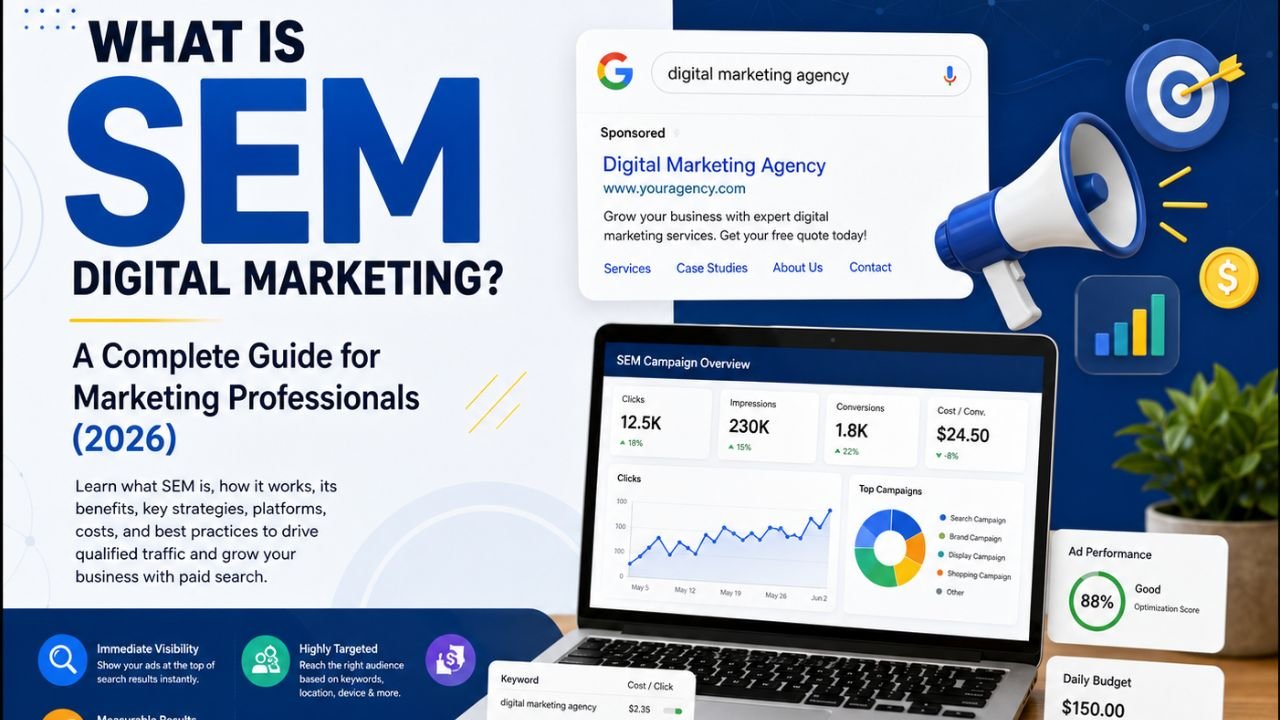
When people need a product, service, or answer, they often begin with a search engine. Businesses compete for this visibility because appearing at the right moment can generate qualified traffic, leads, and sales. One of the fastest ways to gain that visibility is through Search Engine Marketing (SEM).
SEM is a digital marketing strategy that uses paid advertising on search engines to help businesses appear in search results for relevant keywords. While Search Engine Optimization (SEO) focuses on earning organic rankings over time, SEM allows businesses to place advertisements in prominent search positions almost immediately after campaigns are launched.
This guide explains what SEM is, how it works, its advantages, how it differs from SEO, common platforms, best practices, and how beginners can build effective SEM campaigns in 2026.
What Is SEM Digital Marketing?
Search Engine Marketing (SEM) is the practice of promoting websites through paid advertisements that appear on search engine results pages (SERPs).
Advertisers bid on keywords that potential customers search for. When users enter those search terms, search engines may display sponsored advertisements above or alongside organic search results.
SEM helps businesses:
- Increase website visibility
- Generate qualified traffic
- Attract potential customers
- Promote products or services
- Support lead generation
- Drive online sales
Unlike traditional advertising, SEM targets users who are actively searching for information, making it an intent-driven marketing channel.
How Does SEM Work?
Search engines use advertising platforms where businesses create campaigns targeting specific keywords.
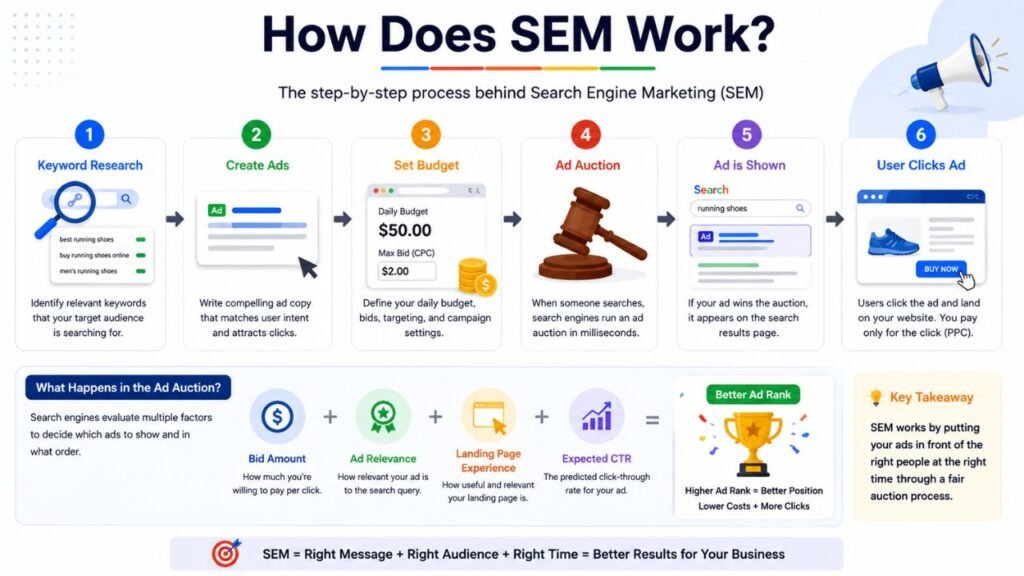
A typical SEM process looks like this:
1. Keyword Research
Identify search terms your target audience uses.
Examples:
- Best running shoes
- SEO consultant
- Digital marketing agency
- CRM software
2. Create Advertisements
Write compelling ad headlines and descriptions that match user intent.
Effective ads usually include:
- Relevant keywords
- Clear benefits
- Strong calls to action
- Accurate landing page information
3. Set Your Budget
Advertisers define:
- Daily budget
- Maximum bid
- Campaign goals
- Geographic targeting
This provides flexibility and control over advertising costs.
4. Ad Auction
When someone searches, search engines evaluate eligible ads based on factors such as:
- Bid amount
- Ad relevance
- Landing page experience
- Expected click-through rate (CTR)
Winning the auction isn’t always about the highest bid—ad quality also plays a significant role.
5. User Clicks the Advertisement
If the ad appears and a user clicks it, they are directed to the chosen landing page.
Most SEM campaigns operate on a Pay-Per-Click (PPC) model, meaning advertisers generally pay only when someone clicks their ad.
Why Businesses Use SEM
SEM offers several advantages for organizations seeking measurable results.
Immediate Visibility
Unlike SEO, which often requires months to build organic rankings, SEM campaigns can begin generating traffic shortly after launch.
Highly Targeted Advertising
Businesses can target users based on:
- Keywords
- Location
- Device
- Language
- Audience interests
- Time of day
This improves campaign relevance.
Measurable Performance
Advertising platforms provide detailed reports on:
- Clicks
- Impressions
- Conversions
- Cost per click (CPC)
- Conversion rate
- Return on ad spend (ROAS)
These insights help marketers optimize campaigns over time.
Flexible Budget Control
Businesses can adjust budgets, pause campaigns, or refine targeting whenever needed.
SEM vs SEO
Although SEM and SEO both improve search visibility, they achieve it in different ways.
| Feature | SEM | SEO |
|---|---|---|
| Traffic Source | Paid search ads | Organic search results |
| Time to Results | Often immediate | Usually gradual |
| Cost | Pay for advertising | No payment for clicks, but investment in optimization |
| Visibility | Sponsored positions | Organic rankings |
| Sustainability | Depends on ongoing ad spend | Can generate long-term traffic with continued optimization |
Many successful businesses combine both SEM and SEO to balance short-term visibility with long-term organic growth.
Popular SEM Platforms
Businesses use several advertising platforms depending on their audience and goals.
Google Ads
The largest search advertising platform, allowing businesses to display ads across Google Search, Shopping, YouTube, Maps, and the Display Network.
Microsoft Advertising
Helps businesses reach users searching through Microsoft’s search ecosystem.
Amazon Ads
Useful for eCommerce brands promoting products directly within Amazon search results.
Retail Marketplace Ads
Many online marketplaces now provide sponsored product advertising to increase product visibility.
Common Types of SEM Campaigns
SEM includes several campaign formats.
Search Ads
Text advertisements appearing within search engine results.
Shopping Ads
Product-focused ads displaying images, prices, and merchant information.
Display Campaigns
Visual advertisements shown across partner websites and apps.
Remarketing Campaigns
Ads targeting users who previously visited your website.
Local Search Ads
Designed to help nearby customers discover local businesses.
Best Practices for SEM Success
To improve campaign performance:
- Research high-intent keywords.
- Match ads to user intent.
- Write clear and compelling ad copy.
- Optimize landing pages.
- Monitor conversion tracking.
- Test multiple ad variations.
- Review search term reports regularly.
- Improve Quality Score through relevant content and user experience.
Continuous testing and optimization are essential for long-term success.
Common SEM Mistakes to Avoid
Many beginners reduce campaign performance by:
- Targeting overly broad keywords.
- Ignoring negative keywords.
- Sending traffic to irrelevant landing pages.
- Forgetting conversion tracking.
- Writing weak ad copy.
- Neglecting mobile optimization.
- Making changes without enough performance data.
A structured approach helps improve efficiency and return on investment.
Is SEM Right for Your Business?
SEM can be valuable for businesses that want to:
- Launch new products.
- Generate leads quickly.
- Increase online sales.
- Promote local services.
- Test marketing campaigns.
- Support seasonal promotions.
However, campaign success depends on clear goals, relevant targeting, quality landing pages, and ongoing optimization.
Frequently Asked Questions (FAQs)
What does SEM stand for?
SEM stands for Search Engine Marketing, a digital marketing strategy that uses paid search advertising to increase visibility in search engine results.
Is SEM the same as SEO?
No. SEM focuses on paid search advertisements, while SEO improves organic search rankings through optimization and content.
Does SEM include PPC?
Yes. Pay-Per-Click (PPC) advertising is one of the most common pricing models used in SEM campaigns.
Which businesses should use SEM?
SEM can benefit businesses of all sizes, including local service providers, eCommerce stores, B2B companies, startups, and established brands looking to attract qualified traffic.
How much does SEM cost?
Costs vary depending on keyword competition, industry, targeting, and campaign goals. Businesses typically set their own advertising budgets and adjust them as needed.
Read also:-
- Top 10 Design Trends to Watch in 2026 | Web, Graphic & UI/UX Design
- Free Stock Photos Websites List (2026): 15 Best Sites for Royalty-Free Images
Final Thoughts
Search Engine Marketing is one of the most effective ways to connect with potential customers at the moment they are actively searching for products or services. By combining targeted keyword research, compelling advertisements, optimized landing pages, and continuous performance analysis, SEM enables businesses to generate qualified traffic and measurable results.
For marketing professionals, SEM should not be viewed as a replacement for SEO but as a complementary strategy. While SEM provides immediate visibility through paid advertising, SEO builds sustainable organic growth over time. Together, these approaches create a balanced digital marketing strategy that supports both short-term objectives and long-term business success.
In 2026, organizations that focus on user intent, relevant advertising, ethical practices, and data-driven optimization will be better positioned to maximize the value of their search marketing investments.
