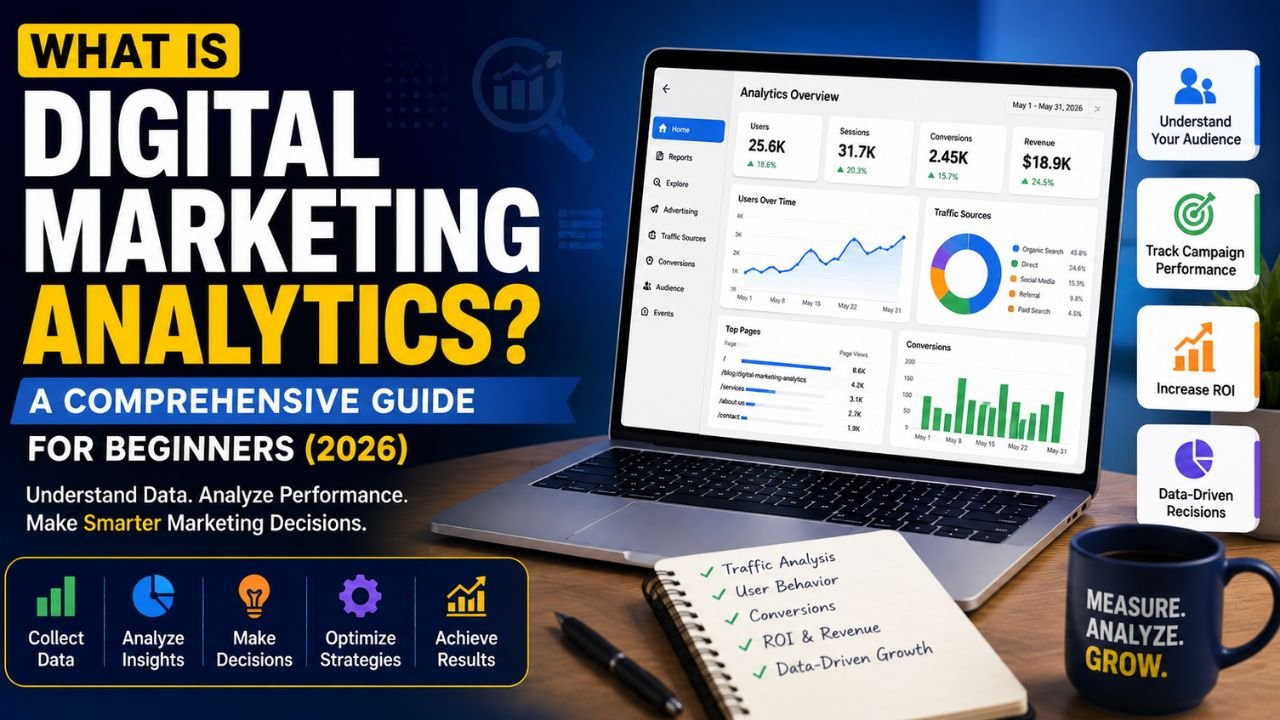
Digital marketing is no longer based on guesswork. Every website visit, advertisement click, email open, social media interaction, and online purchase creates valuable data that businesses can use to improve their marketing strategies. The process of collecting, measuring, and interpreting this data is known as digital marketing analytics.
Whether you run a personal blog, an online store, or a business website, understanding analytics helps you discover what’s working, identify areas for improvement, and make informed decisions instead of relying on assumptions.
This beginner-friendly guide explains what digital marketing analytics is, why it’s important, the key metrics to track, the tools you can use, and best practices for getting the most from your marketing data.
What Is Digital Marketing Analytics?
Digital marketing analytics is the practice of gathering and analyzing data from digital marketing channels to understand user behavior, campaign performance, and business outcomes.
Instead of simply measuring traffic, analytics answers questions such as:
- Where are visitors coming from?
- Which pages attract the most users?
- Which marketing campaigns generate leads?
- What content keeps visitors engaged?
- Which channels produce sales or conversions?
- Why are users leaving a website?
The goal is to turn raw data into insights that guide better marketing decisions.
Why Digital Marketing Analytics Matters
Without analytics, it’s difficult to know whether your marketing efforts are successful.
Analytics helps you:-
- Measure campaign performance.
- Understand customer behavior.
- Improve website usability.
- Increase conversions.
- Optimize marketing budgets.
- Identify high-performing content.
- Track return on investment (ROI).
- Make evidence-based decisions.
Businesses that consistently analyze their marketing data are better positioned to improve performance over time.
How Digital Marketing Analytics Works
Digital marketing analytics follows a continuous cycle:
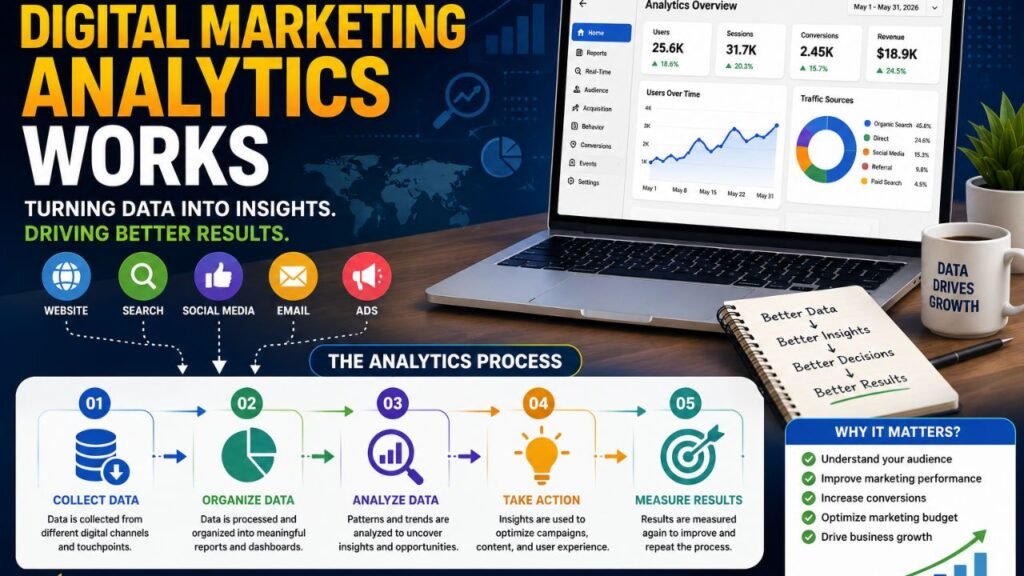
1. Collect Data
Information is gathered from websites, mobile apps, search engines, email campaigns, advertising platforms, and social media.
2. Organize the Data
The collected information is grouped into meaningful reports and dashboards.
3. Analyze Patterns
Marketers look for trends, strengths, weaknesses, and opportunities.
4. Take Action
Insights are used to improve campaigns, optimize websites, create better content, and enhance customer experiences.
5. Measure Results Again
Marketing is an ongoing process. Analytics helps you evaluate the impact of your changes and continue improving.
Types of Digital Marketing Analytics
Website Analytics
Measures how visitors interact with your website.
Examples include:
- Page views
- Sessions
- Bounce rate
- Engagement time
- User flow
SEO Analytics
Focuses on organic search performance.
Important metrics include:
- Organic traffic
- Keyword rankings
- Click-through rate (CTR)
- Indexed pages
- Search visibility
Social Media Analytics
Evaluates content performance across social platforms.
Common metrics include:
- Reach
- Engagement
- Shares
- Followers
- Video views
Email Marketing Analytics
Tracks the effectiveness of email campaigns.
Typical metrics include:
- Open rate
- Click rate
- Unsubscribe rate
- Conversion rate
Paid Advertising Analytics
Measures advertising performance across platforms.
Examples include:
- Cost per click (CPC)
- Cost per acquisition (CPA)
- Return on ad spend (ROAS)
- Impressions
- Conversion rate
Key Metrics Every Beginner Should Understand
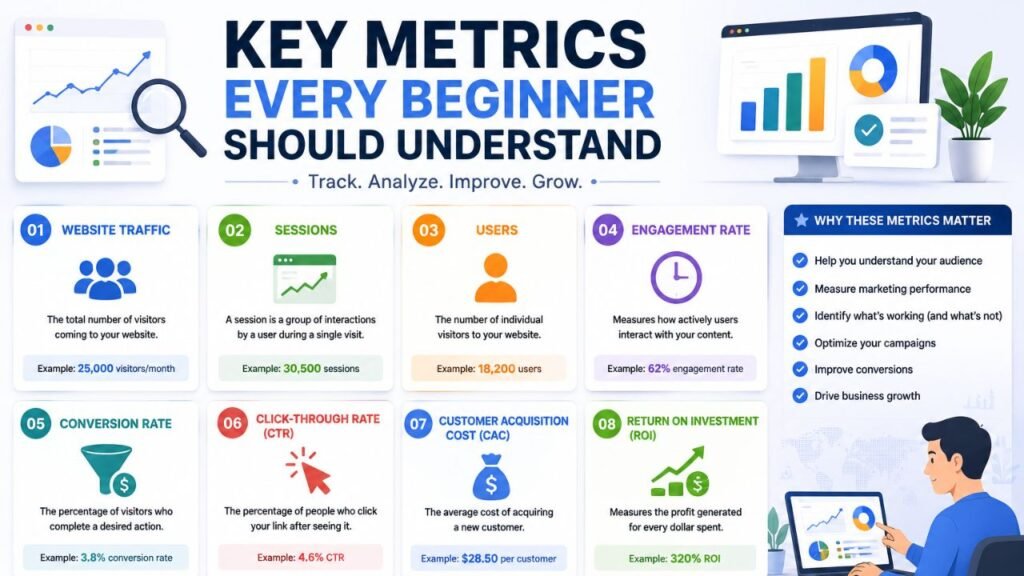
Website Traffic
The number of visitors reaching your website during a specific period.
Sessions
A session represents a group of user interactions during one visit.
Users
Shows how many individual visitors accessed your website.
Engagement Rate
Measures how actively users interact with your content.
Conversion Rate
The percentage of visitors who complete a desired action, such as making a purchase or submitting a contact form.
Click-Through Rate (CTR)
Indicates how often users click your content after seeing it in search results, advertisements, or emails.
Customer Acquisition Cost (CAC)
The average cost of acquiring a new customer through your marketing efforts.
Return on Investment (ROI)
Measures whether your marketing activities generate more value than they cost.
Popular Digital Marketing Analytics Tools
Several tools help businesses collect and analyze marketing data.
Google Analytics 4 (GA4)
A powerful platform for understanding website and app user behavior.
Google Search Console
Helps monitor search performance, indexing, and technical SEO issues.
Google Looker Studio
Creates interactive dashboards using data from multiple sources.
Microsoft Clarity
Provides heatmaps and session recordings to understand user behavior.
HubSpot
Offers analytics for marketing, sales, and customer relationship management.
Semrush
Useful for SEO, keyword research, competitor analysis, and traffic insights.
Ahrefs
Popular for backlink analysis, keyword tracking, and content research.
Benefits of Digital Marketing Analytics
Using analytics effectively can help you:
- Improve marketing campaigns.
- Increase website traffic.
- Understand customer needs.
- Reduce wasted advertising spend.
- Optimize conversion funnels.
- Improve content strategy.
- Enhance user experience.
- Support long-term business growth.
Data-driven marketing reduces uncertainty and helps prioritize the strategies that deliver measurable results.
Best Practices
To get meaningful insights from analytics:
- Define clear business goals.
- Track the right metrics.
- Review reports regularly.
- Compare data over time.
- Test changes using experiments.
- Focus on user experience.
- Protect user privacy and comply with applicable regulations.
- Use multiple data sources when appropriate.
Avoid making major decisions based on a single metric in isolation.
Common Mistakes to Avoid
Beginners often:
- Track too many metrics.
- Ignore conversion data.
- Focus only on traffic volume.
- Forget mobile users.
- Misinterpret short-term fluctuations.
- Neglect data quality.
- Fail to act on insights.
Analytics is valuable only when the information leads to informed improvements.
How Beginners Can Start
If you’re new to analytics:
- Install Google Analytics 4 on your website.
- Verify your site in Google Search Console.
- Define measurable goals.
- Monitor traffic sources.
- Track conversions.
- Analyze your best-performing content.
- Make gradual improvements based on your findings.
Building confidence with a few core metrics is more effective than trying to master everything at once.
Frequently Asked Questions (FAQs)
What is digital marketing analytics in simple words?
Digital marketing analytics is the process of collecting and analyzing online marketing data to understand how users interact with your website, content, and campaigns.
Is Google Analytics free?
Google Analytics 4 offers a free version that provides extensive reporting features suitable for many individuals and businesses.
Why is analytics important for SEO?
Analytics helps you understand which pages attract organic traffic, how users behave after arriving from search engines, and where opportunities exist to improve content and user experience.
What is the difference between analytics and reporting?
Reporting presents data, while analytics interprets that data to uncover insights and support decision-making.
Can beginners learn digital marketing analytics?
Yes. By focusing on foundational concepts and regularly reviewing website performance, beginners can gradually develop strong analytical skills.
Read also:-
- How to Start a Blog and Earn Money From Google AdSense (2026 Beginner’s Guide)
- Free Stock Photos Websites List (2026): 15 Best Sites for Royalty-Free Images
Final Thoughts:-
Digital marketing analytics is an essential skill for anyone involved in online marketing. Rather than relying on assumptions, analytics enables you to understand user behavior, measure campaign effectiveness, and make informed decisions backed by data.
For beginners, the best approach is to start with core tools like Google Analytics 4 and Google Search Console, focus on a handful of meaningful metrics, and build experience over time. As your understanding grows, analytics becomes a powerful tool for improving SEO, content marketing, advertising, and overall business performance.
In 2026 and beyond, organizations that use data responsibly and thoughtfully will be better equipped to create relevant experiences, optimize marketing investments, and achieve sustainable growth.
