Digital marketing is typically described as the act of promoting goods or services via the internet, however that definition only scratches the surface. In the real world digital marketing is an intricate system that incorporates search engines and social media with websites, email campaigns and online ads to get in touch with potential customers.
Contrary to traditional marketing strategies such as newspaper advertisements or commercials on television digital marketing enables businesses to monitor each interaction, analyse the performance of campaigns, and improve them in real-time.
Consider online marketing like a dialogue rather than broadcasting. Traditional marketing talks to everyone in one go in the hope that someone will be interested. Digital marketing however directs its message to those who already are curious.
For instance, if a person is searching on the internet to find “best running shoes,” companies could show advertisements or content that addresses the question. This results in an extremely targeted method which increases the likelihood of converting.
Another crucial aspect is measurability. Businesses can monitor the number of clicks, impressions, clicks and conversions. That means that companies can know precisely what works and what isn’t, which makes digital marketing extremely dependent on data. Instead of guessing which advertising works best, marketers are able to try different strategies and tweak campaigns over time.
In essence digital marketing is an intelligent machine for marketing. It gathers data, analyses patterns, and provides relevant content to prospective customers. Since consumers have more online time than they ever did digital marketing has emerged as one of the strongest tools that businesses can use to build their brand.
The Reasons Businesses Are Moving Online
The shift towards digital marketing wasn’t made overnight. It’s the result of changing behaviours of consumers. Today, nearly everything begins online, whether it’s shopping, researching products, comparison shopping, and reading reviews. Companies that do not establish a web presence are at risk of being invisible to today’s customers.
The main reason for this change is the accessibility. Contrary to traditional advertising that usually requires large budgets for digital advertising, it enables small-sized businesses to compete against larger companies. Local bakeries could, for example, connect with thousands of customers in the area through ads on social media as well as Search engine optimization.
Another reason why companies are shifting online is the capability to concentrate on certain audiences. Instead of displaying ads to everyone, online marketing platforms let brands concentrate on the demographics, interest behavior, even the location. This degree of precision enhances efficiency in marketing.
This creates a marketing space where companies are able to connect with their customers more intimately than they ever have before. Digital marketing is more than just promoting products, it builds relationships with customers which makes it an essential approach for companies in the modern age.
Growth of Digital Marketing Worldwide
The size of the global market and Trends in Spending
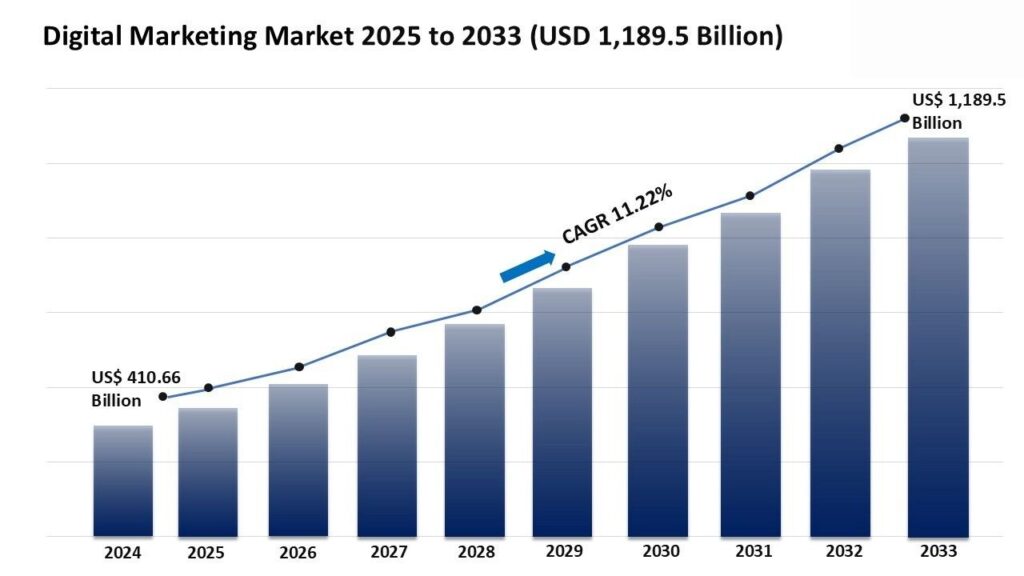
Digital marketing isn’t just an idea, it has become the foundation of modern advertising. The global market for digital ads is projected to reach more than $786 billion in 2026 which is a huge investment by businesses across the world.
More impressive is the amount of marketing budgets that are allocated for digital media. About 70% of all marketing budgets are now devoted to online marketing techniques which shows how prevalent the internet has made advertising. Companies are investing heavily in advertisements on search engines and social media marketing as well as video marketing and content marketing due to the fact that these channels have consistently delivered measurable outcomes.
Another important measure of the growth of digital marketing is the rate of its annual growth. Industry experts forecast an average annual growth rate of 13% or more through 2032 which means that the sector will continue to grow at a rapid pace over the next few years.
This rise is a result of a major shift in how businesses communicate with their customers. Digital platforms can be scaled and scalability, which means a marketing campaign can target a few residents or millions of users worldwide using the same infrastructure. With the growth of internet usage globally and the internet becomes more accessible, digital marketing will increase the importance of businesses who want to be successful for the long term.
The rise of AI and Automation in the field of Marketing
Artificial intelligence is changing digital marketing faster than most experts anticipated. AI-powered tools today help companies analyse customer data, tailor campaigns, and improve strategies for advertising in ways that were impossible 10 years earlier.
Recent industry research has revealed that more than 80 percent of marketers are already using AI-based generative tools and 93% of them have reported tangible returns through these tools. (TechRadar) AI helps automate repetitive tasks like creating content as well as audience segmentation and campaign optimization, which allows marketers to concentrate on strategy and innovation.
Automation also allows predictive marketing. In lieu of responding to consumer behaviour companies can anticipate it. For instance, AI algorithms can analyze patterns of browsing and predict what products customers are likely to buy. The result is that brands can offer customized recommendations that greatly improve the conversion rate.
The incorporation of AI in marketing does not replace human creativity. It improves it. Marketers continue to design strategies but AI assists in executing them more effectively. With the advancement of technology digital marketing is becoming smarter, faster and more efficient than before.
How Digital Marketing Actually Works
The Customer Journey Digital Marketing
To determine if digital marketing is effective in your favor, you must understand what’s happening on the process of acquiring customers. Digital marketing doesn’t only involve making ads, but rather, guiding potential buyers through a series of steps that ultimately result in a purchase.
Marketing strategies generally follow an easy structure called”the” funnel of marketing. The top of this funnel lies the awareness. It is the point at which potential customers find a brand’s name through social media, search engines or through online advertisements. When they are familiar with the company, they go to the phase of consideration. Here, they investigate the products, read reviews and then compare alternatives.
Digital marketing plays an important role in every step of this journey. SEO and content marketing can aid in attracting customers as well as build trust and builds engagement, and emails build relationships. In the end, targeted ads or offers can encourage a buyer to purchase.
What makes digital marketing so effective is the ability to follow each step of the process. Companies can determine the campaigns that generate traffic and which pages convert users to customers and which strategies yield the greatest return on investment.
Awareness and Trust, Conversion and Retention
Effective digital marketing is based on four important phases:
| Stage | Scope | Example Strategy |
|---|---|---|
| Awareness | Attract new audiences | SEO blogs, posts on social media |
| Trust | Create credibility | Educational, reviews, testimonials, content |
| Conversion | Change visitors into buyers | Pay-per-click, landing pages, and paid ads |
| Retention | Retention of customers | Programs for loyalty, marketing via email |
Each stage plays a vital function in the overall strategy for marketing. If customers aren’t aware, they will aren’t likely to discover the company’s name. If they don’t trust the brand, they are hesitant to purchase. Without strategies for conversion, traffic is never converted into income.
Digital marketing is successful because it covers every step of the process in a methodical manner.
Real Data: Does Digital Marketing Deliver Results?
ROI Statisticians across Marketing Channels
One of the most compelling arguments in favor of digital marketing is the ROI. Studies show that companies earn on an annual average of about $5 per $1 invested in digital marketing and proving its efficacy in comparison to traditional methods of marketing. (Thunderbit)
Different marketing channels yield different results. Understanding these differentiators helps companies allocate their budgets efficiently.
| Marketing Channel | Average ROI |
|---|---|
| Email Marketing | As high as $36 for every dollar spent |
| SEO | Around $22 per $1 of investment |
| Influencer Marketing | In the neighborhood of $6.50 per $1 of spending |
| Paid Ads (PPC) | About $2 per $1 of spending |
Email marketing is among the most profitable channels since it targets individuals who already have shown an interest in the brand. SEO can also provide long-lasting results since the organic traffic from search engines continues to produce leads, even after initial investment. (DigiExe)
These numbers show that digital marketing isn’t just efficient, it’s one of most profitable marketing strategies in the present.
The Conversion Rate and the Customer Experience
Beyond ROI Engagement and conversion rates also demonstrate how efficient digital marketing is. Personalized advertisements, for example are able to generate around 80% more engagement rates than generic advertisements. (Thunderbit)
Retargeting ads–which are displayed to those who have visited the site before boost conversion rates by as high as 70 percent. ( Thunderbit) This technique is successful because it focuses on those who have already expressed an curiosity about the product.
These numbers highlight an important fact that digital marketing isn’t only about reaching people. It’s about reaching the appropriate people at the appropriate moment.
Major Benefits of Digital Marketing for Businesses
Cost-effective Marketing is more effective than traditional ads
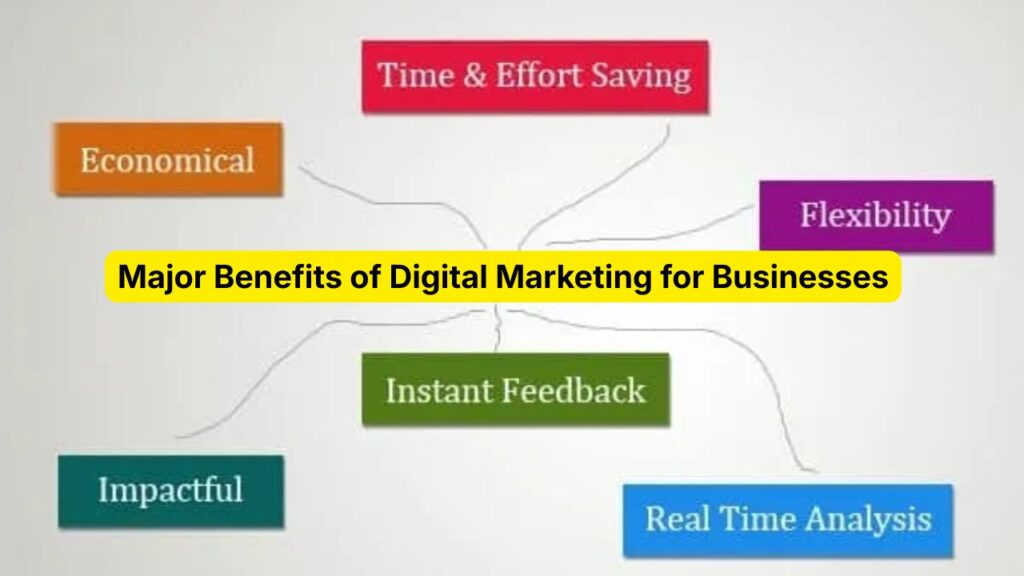
One of the major benefits that digital advertising offers is the cost. Traditional advertising techniques like billboards, television ads or commercials typically need huge budgets, which makes difficult for small companies to afford them. Digital marketing lets companies start with a small investment and then scale campaigns as the results increase.
Online advertising platforms let companies to establish specific budgets and only pay for tangible results. For instance, pay-per-click marketing assures that businesses only pay when people visit their websites. This method reduces the amount of money wasted and increases overall efficiency.
Content marketing is yet another cost-effective method. Making blog posts, videos, and other social media content can bring in long-term traffic with no ongoing advertising costs. Studies have shown that marketing through content costs 62 percent less than traditional marketing and generates three times the amount of leads. (Thunderbit)
Persistent Targeting and personalization
Digital marketing lets businesses effectively target their audiences. Advertisers can target audiences according to geography, preferences, demographics, as well as the behavior of their online users. This allows marketing campaigns to target people most likely take an interest in your product.
Personalization is also a key part. Instead of displaying the same ads to all digital marketing platforms adapt their content for each individual user. This results in an engaging and relevant experience for customers.
Imagine getting an advertisement that is perfectly suited to your needs. Instead of being an unintentional advertisement it’s an enlightening suggestion. This is the power of personalized digital marketing.
Challenges and Misconceptions About Digital Marketing
How some businesses fail with Digital Marketing
However, despite its effectiveness but it doesn’t guarantee the success. A lot of businesses fail due to the fact that they see the process as an instant solution instead of a long-term strategy.
The most common mistake is expecting immediate results. Digital marketing, particularly strategies such as SEO and Content marketing, can take time to gain momentum. Companies that stop their marketing campaigns too soon often do not reap the long-term benefits.
Another problem is poor targeted advertising. If businesses try to reach out to all the message becomes general. Effective digital marketing requires understanding the intended audience and responding to the specific needs of each.
The Issue With Fast Results Expectations
Many companies expect success with viral marketing within a short time. They will launch a few ads and upload articles for a few weeks, and believe that the digital marketing strategy won’t be successful when sales don’t increase in a matter of minutes.
In reality, effective digital marketing requires consistent optimization. Campaigns need to be tested then analyzed and adjusted as time passes. Effective marketers approach digital marketing as an experiment in science, continually making improvements to their strategies based upon information.
Digital Marketing Strategies That Actually Work
SEO, Content Marketing and Social Media
Search engine optimization is an extremely effective online marketing techniques. By optimizing websites to be optimized for search engines, companies can draw organic traffic from people looking for information or products.
Content marketing enhances SEO by providing relevant information that draws and captivates people. Videos, blog posts as well as podcasts and infographics can help establish authority and increase trust with potential customers.
Social media marketing is a new level of engagement. Platforms like Instagram, TikTok, and LinkedIn allow brands to engage with their followers in real-time to build stronger connections and boosting brand recognition.
Paid Adverts and Influencer Marketing
Paid advertising improves the results of campaigns by putting products directly to potential buyers. Platforms such as Google Ads or social media advertisements allow for extremely targeted ads that produce tangible results.
Influencer marketing is also an effective strategy. Customers tend to trust recommendations from influencers more than traditional ads. Research shows that influencer campaigns yield return on investment of approximately $6.50 per dollar which makes them an extremely effective marketing channel.
Is Digital Marketing Worth It for Small Businesses?
For small-sized businesses, digital marketing could be a game changer for small-scale businesses. Local gyms, restaurants, salons and retail stores typically rely on online marketing to draw in customers from nearby.
A basic Google search result, when combined with social media promotions along with targeted advertising, will significantly boost the visibility of local companies. Even tiny marketing budgets can yield impressive results when campaigns are designed and designed.
The most important thing is the consistency. Businesses that publish regularly content, engage with customers, and analyse the performance of their customers tend to get the most effective outcomes.
Future of Digital Marketing
Future digital marketing trends will be determined by three major factors: artificial intelligence personalization, personalization, and data analytics.
AI will continue to automate tasks such as the creation of content along with campaign optimization and segmenting customers. The personalized marketing experience will get even more sophisticated as brands deliver extremely customized content based on the individual’s preferences.
Data-driven marketing is also becoming more sophisticated. Companies will depend in analytics software to analyze customer behaviour and predict the future direction of events.
These advancements can make digital marketing more effective, which will guarantee its dominance in the world of advertising.
Conclusion:-
Digital marketing is absolutely effective, but only if it’s done right. The research clearly shows that companies investing in digital marketing can reap impressive returns, greater visibility, and more effective relationships with their customers. Starting from SEO, content marketing and even, to social media and paid ads digital marketing can provide many strategies to help brands reach their customers efficiently.
The crucial element to success is the strategy, consistency, and constant improvement. Businesses that view digital marketing as an investment for the long term instead of an immediate fix are more likely to sustain growth. As technology develops and the use of online technology continues to be the dominant factor in modern society digital marketing will be among the top effective instruments for business growth.
FAQs:-
1. Do digital marketing strategies work for small-sized businesses?
Yes, digital marketing can be particularly effective for small-sized businesses since it lets them target their customers without massive budgets for advertising.
2. How long will digital marketing need to be before delivering outcomes?
Certain strategies, like paid advertisements will yield results fast however other methods like SEO or content marketing can take several months to develop.
3. How can I determine the most efficient way to market your business online?
Marketing via email and SEO can yield the greatest ROI, however the optimal strategy will depend on the type of business and market.
4. Does digital marketing have more value than traditional marketing?
Digital marketing provides more precise targeting, tangible results, and less expensive as compared to traditional marketing strategies.
5. Does digital marketing work with an enormous budget?
Many strategies, including Content marketing, SEO or social media advertising, can produce significant results even with smaller budgets.